
In this article
- Introduction
- Who Still Wears a Suit to Work
- What a Dress Code Can Actually Ask of You
- Navy or Charcoal: The Only Two Colours You Need to Start
- Fit Is Where the Authority Comes From
- Cloth: Built for an Office Year, Not a Season
- Building a Small Rotation That Works Harder
- Frequently Asked Questions
- Conclusion
The short answer
Suits are no longer everyday office wear - YouGov found only 7% of UK workers wear business attire - so a business suit now does specific jobs: interviews, client-facing and City roles, and formal events. For those, a plain navy or charcoal two-piece in a mid-weight wool, fitted properly at the shoulder and sleeve, covers almost every situation.
The office suit has changed jobs. It used to be a daily uniform; now it is the thing you wear when the day matters - an interview, a pitch, a board meeting, a client who still dresses formally. That changes what a good business suit is. It no longer needs to survive five days a week, but it does need to look exactly right on the days it is worn. This guide covers who still wears a suit to work, what an employer can actually ask of you, and how to choose the colour, fit and cloth of a suit that earns its place in a smaller wardrobe.
Who Still Wears a Suit to Work
The numbers are stark. In a November 2023 survey, YouGov found that just 7% of UK workers wear business attire to work, including 8% of male workers. Smart casual has become the most common workplace dress, worn by 34% of workers.
The suit has not disappeared evenly, though. The same YouGov survey found that 13% of workers in the highest-grade managerial and professional occupations still wear one - well above the average. Hybrid working has reinforced the split: the Office for National Statistics found that 28% of working adults in Great Britain were hybrid working in autumn 2024, rising to 45% of managers, directors and senior officials in spring 2024. When the office days are fewer, they are more often the days with meetings.
Job adverts show the same shift. Analysis by the hiring platform Indeed, reported by Euronews, found that 3.3% of UK job postings mentioned casual dress in July 2025, against just 0.2% in the first half of 2019. London had the lowest share, at 2.3% - attributed to its concentration of financial-services roles, where formal dress is still expected.
The practical reading: if you work in finance, law or a client-facing role, or you are interviewing, a suit is still the expected standard. Everywhere else, it has become a tool for specific occasions - which is exactly why the one you own should be a good one.
 Illustrative image
Sources: YouGov, Office for National Statistics, Euronews
What a Dress Code Can Actually Ask of You
An employer in the UK can require a suit. Government guidance published in 2018 confirms that dress codes may set different requirements for men and women, provided the overall standard is equivalent - so an employer can ask men to wear a suit and tie as long as women face an equivalent level of formality.
The same guidance notes that a general requirement to dress smartly is lawful if it is applied equally, and that it does not itself have the force of law - it explains how the Equality Act applies rather than creating new rules. The point for a job seeker is simple: if a role expects a suit, that expectation is legitimate, and it is safer to arrive dressed to it.
When an invitation to a business event says "lounge suits", Debrett's gives the clearest definition: for men, a dark or grey suit, collar and tie, and formal, polished black shoes. It adds that lounge suits are worn for most business events, both daytime and evening. That is a useful benchmark for any formal working occasion.
Sources: Government Equalities Office (GOV.UK), Debrett's, Debrett's
Navy or Charcoal: The Only Two Colours You Need to Start
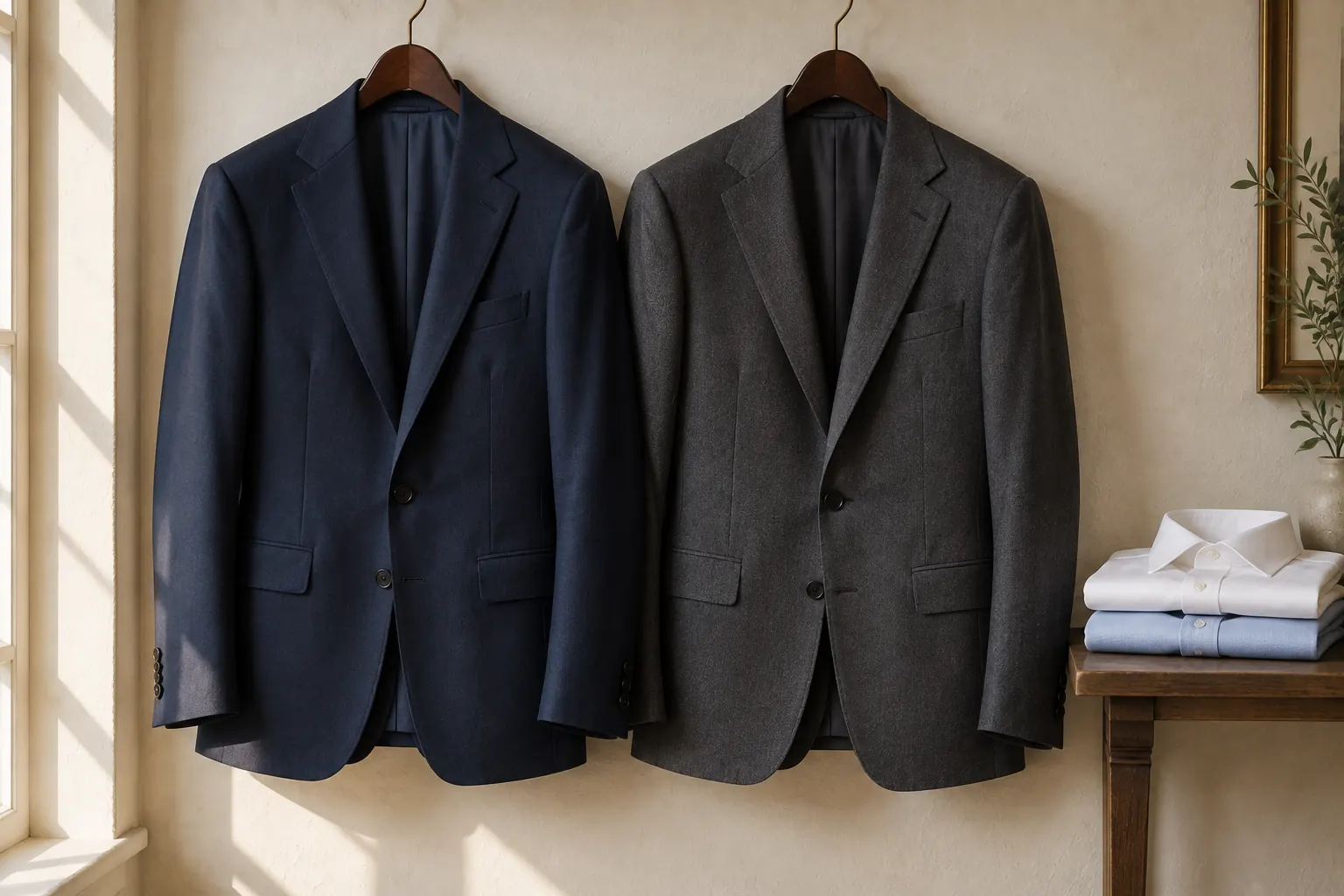
Debrett's "dark or grey suit" definition narrows the field quickly. In practice, navy and charcoal cover almost every formal working situation, and owning one of each gives you a rotation that never looks repetitive.
 Illustrative image
| Colour | Best for | Watch out for |
|---|---|---|
| Navy | Interviews, client meetings, daytime events; the most versatile first suit | Very bright navy reads as fashion rather than business |
| Charcoal | Board meetings, formal and evening business events, funerals | Can look severe with a black tie; soften with blue or burgundy |
| Mid-grey | Daytime, spring and summer, less formal offices | Lighter greys look less formal after dark |
| Black | Evening events and funerals | Reads as evening or occasion wear rather than business in daylight |
| Pinstripe or chalk stripe | Finance and law, as a second or third suit | Bold stripes date faster than plain cloth |
Fit Is Where the Authority Comes From
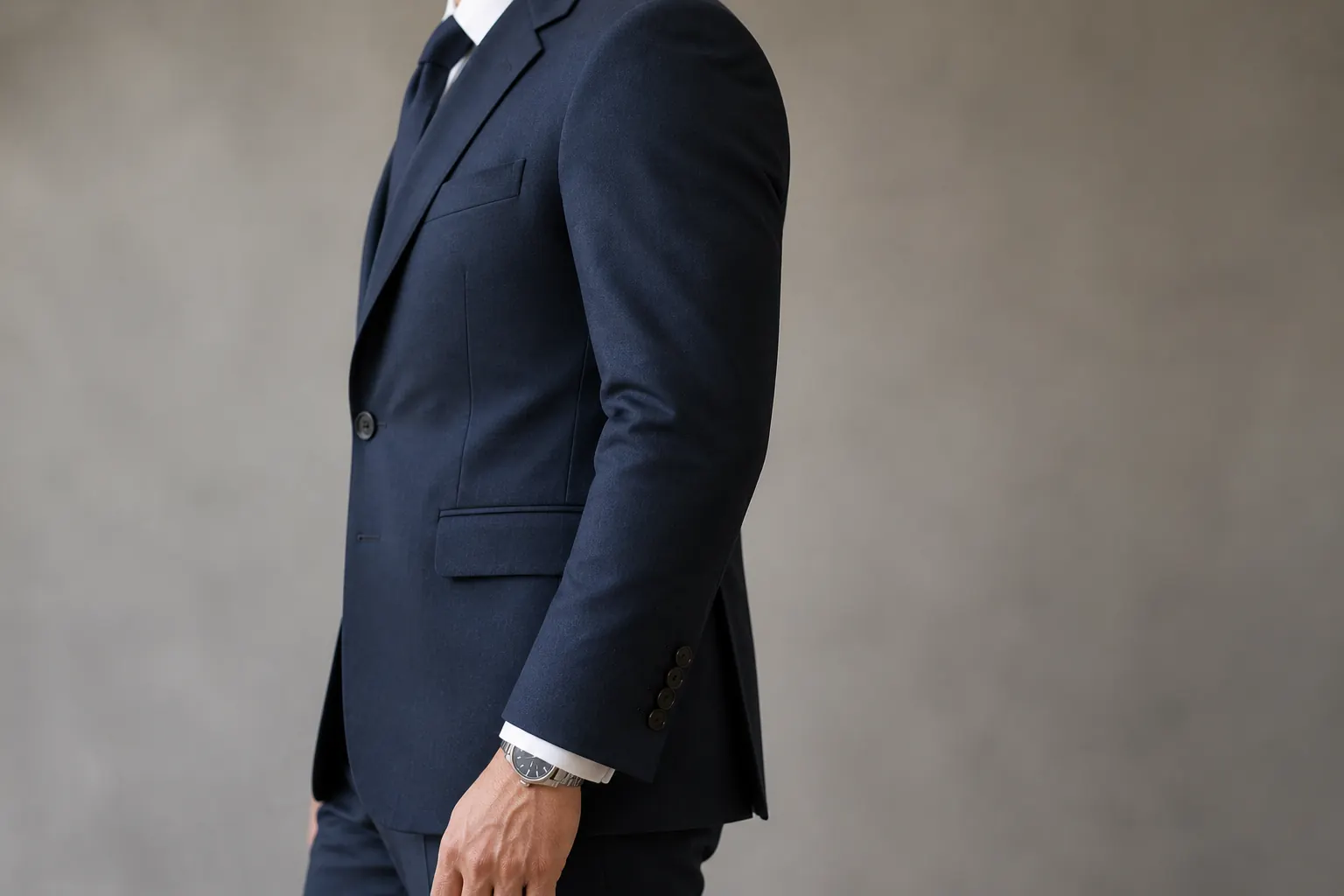
A modest suit that fits looks more expensive than an expensive one that does not. These are the five points to check in a fitting room, in order of how hard they are to fix.
 Illustrative image
- 1
Shoulders
The shoulder seam should end at the edge of your shoulder, with no dent below it and no padding hanging past it. Shoulders are the hardest part of a jacket to alter, so if they are wrong, choose a different size.
- 2
Chest and button
With the top button fastened, the front should lie flat. An X-shaped pull around the button means the jacket is too tight; loose folds mean it is too big.
- 3
Jacket length
A business jacket should broadly cover your seat. Very short jackets read as fashion rather than business.
- 4
Sleeve length
By convention a little shirt cuff - around a centimetre - shows below the jacket sleeve with your arms relaxed. Sleeves are an easy alteration.
- 5
Trouser length
A slight or no break keeps the line clean over a business shoe. Hems are the cheapest alteration of all, so never reject a suit because of trouser length alone.
Cloth: Built for an Office Year, Not a Season
Because a business suit may be worn from January to July, it should be cut from a year-round cloth rather than a summer or winter weight. Worsted wool in a mid weight is the standard for good reason: it holds a crease, resists wrinkling in a meeting and recovers overnight on a hanger.
On the label, a Super 100s to 130s wool is the practical range for regular wear - fine enough to drape well without being delicate. Our guide to Super numbers explains what the figure actually measures, and why higher is not automatically better for a suit you wear often.
Avoid suits where synthetics make up most of the shell cloth. They may look sharp in the shop, but they breathe poorly in a warm meeting room and tend to shine with wear.
Building a Small Rotation That Works Harder
With a suit worn a few times a month rather than every day, a small rotation goes further than it used to. Two suits and a handful of accessories cover almost every business occasion.
Two suits, alternated
A navy and a charcoal. Resting a wool suit for a day between wears lets creases drop out and makes both last longer.
White and light blue shirts
Both work with both suits, with every tie, and in every meeting. Add pattern only once these are covered.
Three ties
A plain navy, a burgundy and a subtle pattern. Debrett's lounge-suit definition includes a tie, so keep one at work even if the day-to-day code is open-necked.
Black shoes
Debrett's specifies formal, polished black shoes for lounge suits. A black Oxford is the one shoe that is correct with both suits at every business event.
Sources: Debrett's
Frequently Asked Questions
Do people still wear suits to work in the UK?
Far fewer than before. A 2023 YouGov survey found only 7% of UK workers wear business attire to work, rising to 13% in the highest-grade managerial and professional jobs. Suits remain the norm in finance, law and client-facing roles, and for interviews.
What colour suit is best for a job interview?
Navy or charcoal. Both match Debrett's definition of lounge-suit business attire - a dark or grey suit with a collar and tie - and both look serious without looking severe. Navy is slightly friendlier; charcoal slightly more formal.
Can my employer make me wear a suit?
Generally, yes. UK government guidance from 2018 says dress codes can set different requirements for men and women, such as a suit and tie for men, provided the overall standard of formality is equivalent for both sexes and the code does not discriminate.
Is a black suit appropriate for business?
It is better kept for evening events and funerals. In daylight, black reads as occasion or evening wear, while navy and charcoal read as business. If you own only one suit for work, choose navy or charcoal instead.
How should a business suit fit?
Check the shoulders first - the seam should end at your shoulder edge - then make sure the front lies flat when buttoned, the jacket broadly covers your seat, a little shirt cuff shows below the sleeve, and the trousers have a slight or no break. Sleeves and hems are easy to alter; shoulders are not.
What fabric should a business suit be?
A mid-weight, year-round worsted wool, ideally in the Super 100s to 130s range. It resists creasing, recovers overnight and is fine enough to drape well without being delicate. Avoid suits whose shell is mostly synthetic.
Conclusion
The business suit has gone from a daily uniform to an occasion garment for work - and that raises the bar rather than lowering it. Start with a plain navy, add a charcoal, buy year-round wool in the Super 100s to 130s range, and put the budget into fit rather than a label. On the days a suit is still expected, that is what will be noticed.
References
- The death of business attire? Just 7% of workers wear a suit to work — YouGov, 2023
- Who are the hybrid workers? — Office for National Statistics, 2024
- Casual is the new corporate: UK offices redefine workwear norms — Euronews, 2025
- Dress codes and sex discrimination: what you need to know — Government Equalities Office (GOV.UK), 2018
- Addressing the Dress Code — Debrett's
- Deconstructing Dress Codes — Debrett's
James Sterling covers business and everyday tailoring for Search For Suits. He grounds workplace dress advice in published sources - UK government guidance, Debrett's, and survey data from YouGov and the ONS - and keeps the difference between a rule and a preference explicit.