In this article
The short answer
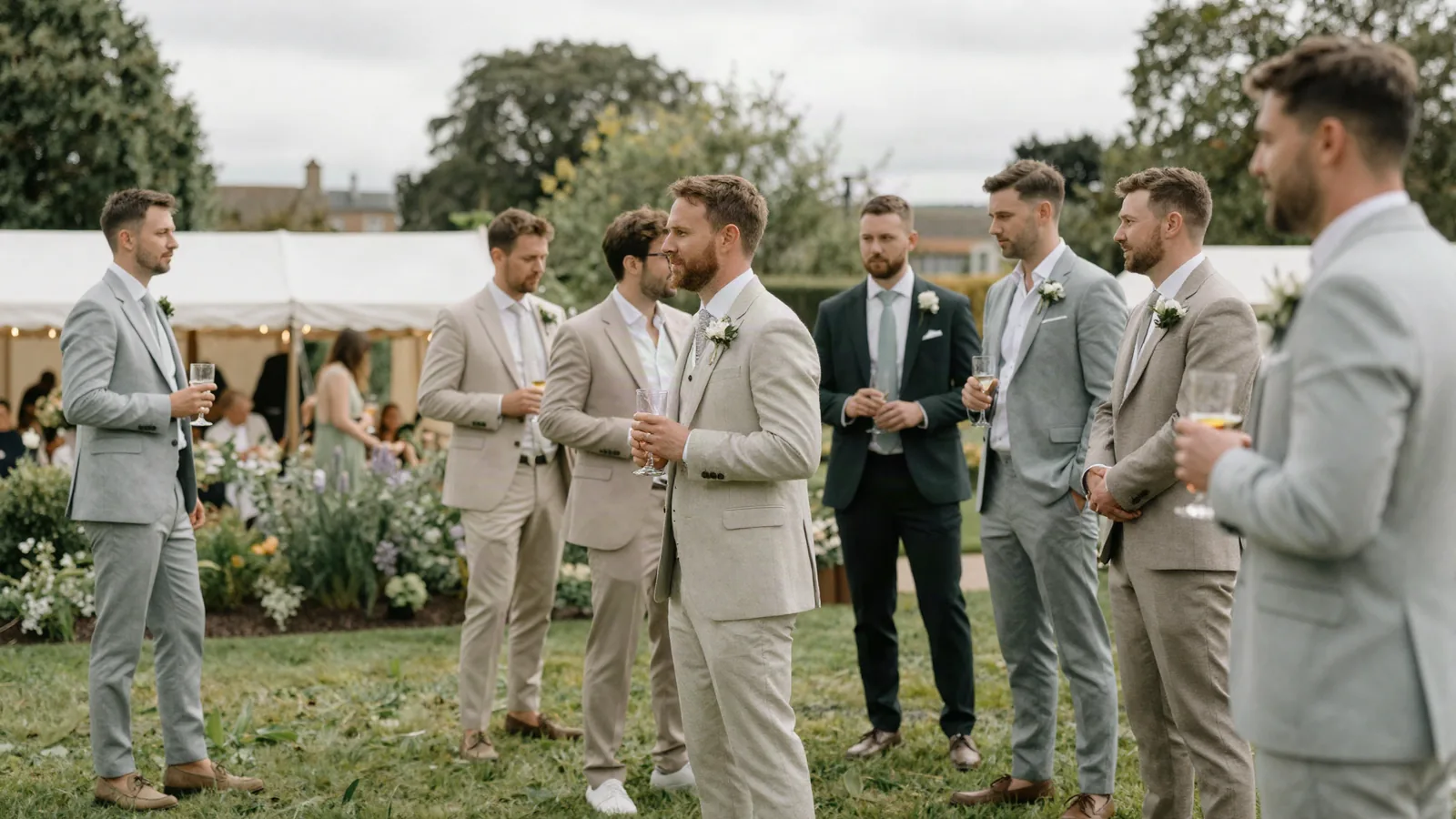
For a UK summer wedding, wear an unlined or half-lined suit in a lightweight wool (7-9oz), linen, or wool-linen blend. Light grey, sand, sage and mid-blue all photograph well outdoors. Unless the invitation says black tie or morning dress, a lounge suit is the correct default - the code Debrett's lists for most British weddings.
August is the single most popular month to marry in England and Wales, accounting for 14.3% of all marriages in 2023 (ONS). Yet the UK summer those weddings fall in is mild rather than hot: July normals are a daily maximum of about 20C and a minimum of 11C, and even Kew in west London averages only 24C. That gap - a warm marquee at three o'clock, a cool churchyard at seven - is the actual design problem. The answer is not a lighter colour. It is a lighter cloth, and everything that makes a summer suit comfortable happens in the weave and the lining rather than the shade.
First, Decode the Dress Code
Most confusion at British weddings comes from invitations that use formal terms loosely. Before choosing anything, work out which of the four codes you are actually being asked for - they are genuinely different outfits, not degrees of the same one.
If the invitation says nothing at all, the default for a UK summer wedding is a lounge suit. That is the standard two-piece or three-piece business-style suit, and it is what the overwhelming majority of guests will be wearing. When in doubt, a mid-blue or light grey lounge suit is never wrong.
One rule overrides all of the below: never wear ivory, cream, or an all-white suit to someone else's wedding unless the couple has explicitly asked for it. The same goes for anything that reads as bridal at a distance in photographs.
| Dress code | What it means | Summer-appropriate version |
|---|---|---|
| Lounge suit | Standard two- or three-piece suit. The UK default. | Light grey or mid-blue, unlined, no tie or a knitted tie |
| Morning dress | Morning coat, waistcoat, formal striped trousers. Daytime formal. | Lightweight wool morning coat; buff or dove-grey waistcoat |
| Black tie | Dinner jacket and bow tie. Strictly an evening code. | Ivory or midnight-blue dinner jacket, lightweight barathea |
| Smart casual | No tie required, jacket usually still expected. | Linen blazer with separate chinos, open collar |
Sources: Debrett's
Fabric and Weight: The Part That Actually Matters
Suit cloth is measured in ounces per yard. This single number tells you more about summer comfort than colour, brand, or price. A 7oz suit and a 13oz suit in identical navy will feel like completely different garments in a July marquee.
Aim for 7-9oz. Tropical wool - the classic warm-weather suiting - is generally specified between roughly 7.5oz and 10oz per yard. Cloth merchants treat 7oz as summer-specific and 8oz as a spring/summer weight, while 9oz is the one sold as a year-round or four-season cloth and 11-12oz is where flannels and tweeds begin. That is the trap: a suit bought to cover every season is, by definition, not cut for the warmest one. Check the weight on the label rather than assuming.
Weave matters as much as weight. Tropical wool is made from tightly twisted worsted yarns woven in an open plain weave, which leaves visible space between the threads so air can move through the cloth rather than sitting against the skin. This is why a loosely woven cloth can feel cooler than a tightly woven one of the same or lower weight - airflow does more work than raw ounces.
The fibre itself helps more than most people expect. The Woolmark Company reports that wool moves about 25% more moisture away from the skin than polyester - equivalent to an ambient temperature drop of up to four degrees - and can absorb up to 35% of its weight before it feels wet. In warm conditions wool fabrics can feel up to twice as cool to the touch as synthetics, because wool conducts heat away from the skin. That is the measurable case against the polyester-blend suit.
Then check the lining. A fully lined jacket carries a second layer of cloth across your whole back. Unlined or half-lined construction removes most of it, and it is the cheapest single upgrade in summer comfort. If a jacket is described as unstructured or unlined, that is a summer jacket.
| Fabric | Breathability | Creasing | Best for |
|---|---|---|---|
| High-twist wool (fresco) | Excellent | Very low | The all-round best summer choice |
| Linen | Excellent | High - it is meant to | Beach, garden and destination weddings |
| Wool-linen blend | Very good | Moderate | Linen-like coolness without the full crumple |
| Cotton / chino cloth | Good | Moderate | Relaxed countryside and smart-casual |
| Standard worsted wool | Moderate | Low | Air-conditioned venues, cooler days |
| Polyester blend | Poor | Low | Avoid in summer - it traps heat |
Sources: Threads Magazine, The Woolmark Company, Articles of Style
Choosing a Colour That Survives the Photographs
Summer weddings are photographed in harsh, high-contrast daylight, often outdoors. Colours that look safe indoors can behave badly under a bright sky, and a black suit in particular reads as heavy and funereal in July sunlight.
Light grey
The most reliable British summer colour. It holds detail in bright daylight rather than flattening out the way very dark cloth does, and it is equally at home in a church, a garden or a barn.
Mid and airforce blue
Warmer and more photogenic than navy in bright sun, while staying conservative enough for a formal ceremony.
Sand and stone
Excellent for marquees and destination weddings. Choose a wool-linen blend so it holds shape through a long day.
Sage and olive
The current favourite for countryside weddings. Sits well against greenery and reads as considered rather than loud.
Navy
Never wrong, but pick it in a genuinely lightweight cloth or it becomes the warmest option in the room.
Black - avoid
Correct only for black tie after 6pm. In daylight it absorbs heat and photographs flat.
Fit: The Three Checks That Do Most of the Work
A moderately priced suit that fits properly outperforms an expensive one that does not. If you take nothing else from this guide, take these checks - they cost nothing and a tailor can correct all of them cheaply.
Allow time for alterations, and ask for the turnaround before you buy - it varies by tailor and lengthens sharply through peak wedding season. Sleeve length, trouser hem and a light waist suppression cost far less than most people expect, and do more for how a suit looks than spending more on the suit itself. Buying three weeks out leaves room for a second fitting if the first is not right.
- 1
The shoulder seam
The jacket's shoulder seam should sit exactly where your shoulder ends and your arm begins. This is the one thing a tailor cannot easily fix, so it decides whether a jacket is worth buying at all.
- 2
The jacket button
Fasten the top button and stand naturally. You should be able to slide a flat hand between the button and your chest. Any pulling that makes an X-shape across the button means it is too tight.
- 3
The trouser break
For summer, ask for a slight break or none at all - the hem just touching the shoe. A heavy stacked break looks sluggish in warm weather and drags in grass.
- 4
The shirt cuff
Roughly 1-1.5cm of shirt cuff should show below the jacket sleeve. If none shows, the sleeves are too long, which is the most common and most fixable fault on a suit bought off the peg.
Shirt, Tie and Shoes
Summer is where accessories get lighter rather than fewer. The instinct to add a heavy silk tie and polished black Oxfords to a light suit is what makes many guests look mismatched in photographs.
Shirt
White or pale blue poplin for formal ceremonies. For garden and marquee weddings, an oxford or a fine linen-blend shirt breathes noticeably better.
Tie
For an outdoor summer wedding, a knitted silk or linen tie in a matte texture works far better than heavy satin. Many British summer weddings are now comfortably no-tie unless stated.
Shoes
Tan or oxblood leather over black, in a Derby or loafer. Black Oxfords belong with black tie and business suits, not a sand linen suit in a field.
Socks
Mid-calf, so no skin shows when seated. Lisle cotton over thick wool.
Pocket square
Linen rather than silk in summer. Complement the tie, do not match it exactly.
What to skip
A waistcoat in genuine heat, tie bars over a knitted tie, and any three-piece configuration for an outdoor July ceremony.
Planning for British Weather Specifically
The distinguishing feature of a UK summer wedding is not heat but range. Against 1991-2020 climate normals, a UK July day averages about 20C at its warmest and 11C at its coolest - and regional spread is real, with Kew averaging a 24C maximum while Edinburgh averages 19C. A ceremony in a cool stone church, photographs in full sun, drinks in wind, and a marquee after sunset can span most of that range in a single afternoon.
That daily range - roughly nine degrees between average maximum and minimum - is the strongest argument for a three-piece, or for carrying a lightweight knit. A waistcoat lets you remove the jacket during the warmest part of the day without looking undressed, then re-layer in the evening. If the forecast is genuinely hot, leave the waistcoat and bring a fine merino crewneck for after dark instead.
For marquee and garden weddings, check the ground before choosing shoes. Leather soles offer little grip on wet grass and absorb moisture readily, so a rubber-soled Derby or a sturdy loafer is usually the better call than your smartest Oxfords. If the venue is a working farm or a beach, that decision matters more than the suit does.
Finally, plan for rain even in July. A packable, unlined overcoat or a compact umbrella in the car is not over-preparation in Britain - it is the difference between an inconvenience and a ruined linen jacket.
Sources: Current Results, Met Office
Frequently Asked Questions
Can I wear a black suit to a summer wedding?
It is best avoided. Black is a formal evening colour and reads as sombre in daylight, as well as absorbing significantly more heat. Unless the invitation specifies black tie, choose light grey, mid-blue, sand or sage instead.
Do I need to wear a tie to a summer wedding in the UK?
Not usually. Unless the invitation states morning dress, black tie, or an explicitly formal code, an open collar is widely accepted at British summer weddings. If you prefer a tie, choose a knitted silk or linen one rather than heavy satin.
Is linen too casual for a wedding?
No, but it depends on the venue. Linen is well suited to garden, beach, marquee and destination weddings. For a formal church ceremony, a wool-linen blend gives you the same coolness with a crisper finish and far less creasing.
What suit weight is best for a British summer?
Between 7oz and 9oz. Cloth sold as 'year-round' or 'four-season' is typically 9oz and up, so a suit bought to cover every season is not cut for the warmest one - check the weight on the label. Also check the lining: an unlined or half-lined jacket is noticeably cooler than a fully lined one of the same weight.
Should I wear a three-piece suit to a summer wedding?
Only in moderate weather. A waistcoat is genuinely useful in the UK because it lets you remove your jacket in the afternoon and re-layer when the temperature drops after sunset. In real heat, skip it and bring a fine merino knit for the evening instead.
What colour shoes go with a light grey or sand summer suit?
Tan or oxblood leather, in a Derby or loafer. Black shoes belong with black tie and dark business suits and look heavy against summer cloth. If the venue has grass, choose a rubber sole over a leather one.
How far in advance should I buy a wedding guest suit?
At least three weeks. Alterations - sleeve length, trouser hem, a light waist adjustment - do more for how a suit looks than spending more money does, but turnaround varies by tailor and gets longer through peak wedding season, so ask before you buy.
Conclusion
Get the cloth weight right and the rest of a summer wedding outfit becomes straightforward. Choose a 7-9oz wool, linen, or wool-linen blend; keep the jacket unlined or half-lined; pick a colour that reads well in daylight; and have the shoulders, sleeves and hem checked by a tailor at least three weeks out. Do that and you will be comfortable through both the sunshine and the inevitable shower.
References
- Marriages and civil partnerships in England and Wales: 2023 — Office for National Statistics, 2025
- UK climate averages (1991-2020 standard reference period) — Met Office
- Average July Temperatures in the United Kingdom (1991-2020 normals) — Current Results
- Wool is naturally breathable — The Woolmark Company
- Sew with Tropical Wool Suiting — Threads Magazine, 2026
- A Guide to Fabric Weights — Articles of Style
- Addressing the Dress Code — Debrett's
Alexander West covers British tailoring and formalwear for Search For Suits, where he reviews suiting from UK retailers against cloth specification, construction and fit. He writes with reference to published textile research and UK dress-code convention rather than seasonal trend cycles.